
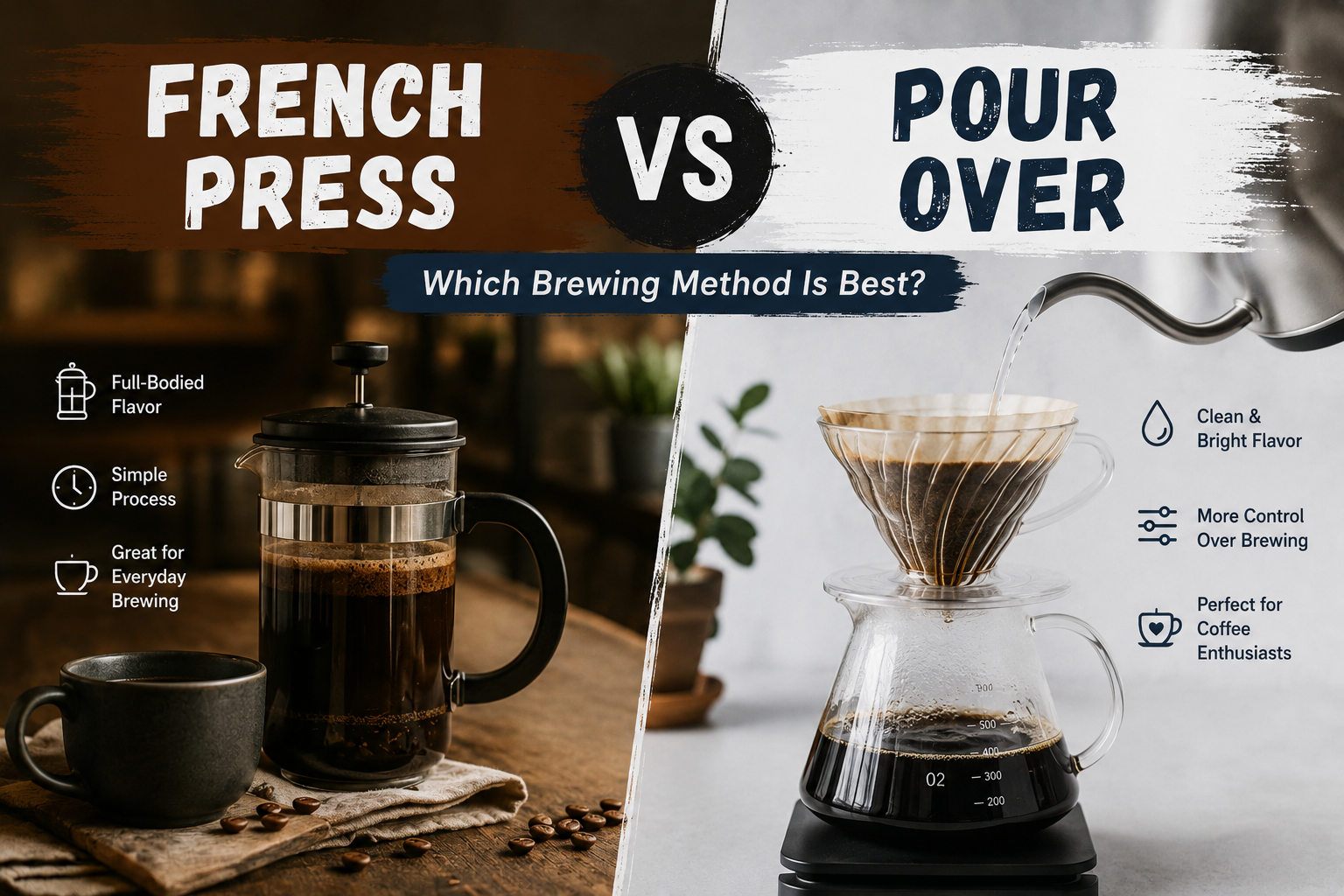
French Press vs Pour Over: Which Brewing Method Is Best?
French Press vs Pour Over: a practical comparison
When choosing between French Press vs Pour Over, the decision usually comes down to what you want from your cup: full-bodied richness or clean clarity. Both methods are beloved by home brewers and specialty cafes alike. This guide walks through taste, texture, equipment, time, and cleanup so you can pick the method that fits your mornings and your beans.
How the methods differ at a glance
- French Press: Immersion brewing with metal mesh filter. Produces heavy body, oils, and pronounced mouthfeel.
- Pour Over: Manual drip through a paper or cloth filter. Emphasizes clarity, subtle flavors, and acidity.
Flavor, body, and clarity — what to expect
With French Press, coffee steeps in hot water for several minutes and the metal filter allows fine particles and oils into the cup. The result is a heavier, more viscous drink that highlights body and sweetness. Pour Over uses a paper filter to trap oils and fines, producing a cleaner, brighter cup where nuanced aromatics and acidity stand out.
Which is better for single-origin beans?
If you want to taste delicate floral or fruity notes from a single-origin bean, pour over often performs better because it isolates flavors. If you enjoy the sensation of a fuller, more dessert-like cup—especially with darker roasts or blends—the French Press shines.
Grind size, brew time, and technique
- French Press: Coarse grind, 1:12–1:15 coffee-to-water ratio, steep 3–5 minutes, plunge slowly. Avoid extremely fine grind to reduce silty sediment.
- Pour Over: Medium-fine to medium grind, 1:15–1:17 ratio, bloom 30–45 seconds then pour in concentric circles, total brew 2:30–3:30 minutes for most drippers.
Consistency in grind and water temperature (195–205°F / 90–96°C) matters for both methods. A digital scale and a timer are arguably the best inexpensive upgrades for reliable results.
Equipment, cost, and counter space
- French Press: Simple—press, kettle, scale. Glass or stainless options range from budget to premium. Fewer accessories required.
- Pour Over: Requires dripper (V60, Kalita, Chemex), filters (paper or cloth), gooseneck kettle for control, scale, and often a carafe. Slightly more gear but greater control.
For small kitchens, a compact French Press may be easier to store. If you already enjoy specialty gear, pour over adds ritual and precision.
Cleanup and durability
Cleanup is a practical consideration. French Press cleanup involves scooping grounds and rinsing the carafe; metal filters need occasional deep cleaning to remove oils. Pour over cleanup can be as simple as discarding a paper filter and rinsing the dripper—paper filters also remove oils, affecting flavor.
Which is faster for a single cup?
Pour over can be slightly faster in active time but requires attention to pouring. French Press involves a waiting period for steeping but is largely hands-off during the brew. For quick preparation, either method can be efficient once you’re practiced.
Best uses and pairing
- French Press: Breakfast blends, dark roasts, and any cup where body and mouthfeel are the priority.
- Pour Over: Light to medium single-origin beans, tasting sessions, and when clarity and complexity matter.
Expert tips to improve both brews
- Use freshly roasted beans and grind immediately before brewing.
- Measure by weight, not volume—consistency is key.
- Stabilize water temperature: let boiling water rest 30 seconds before pouring.
- For French Press, decant into a separate carafe after plunging to prevent over-extraction.
- For Pour Over, practice steady pouring and test small changes in grind to dial extraction.
French Press vs Pour Over: final decision factors
Choose French Press if you want bold flavor and texture with minimal gear. Choose Pour Over if you prefer nuanced clarity and are happy to fine-tune technique. Both reward quality beans and attention to detail.
References and further reading
Technique and standards for extraction are well documented by the Specialty Coffee Association (https://sca.coffee) and the National Coffee Association provides useful consumer insights (https://www.ncausa.org). For brewing ratio experiments and science-backed tips, those organizations offer excellent resources.
FAQ
-
Is French Press stronger than pour over?
French Press often feels stronger due to greater body and retained oils, but strength also depends on grind size and coffee-to-water ratio. Adjust ratios to match your preference.
-
Does pour over make better coffee?
“Better” depends on taste. Pour over excels at clarity and highlighting subtle flavors; it’s preferred for light single-origin beans. For richness and texture, some prefer French Press.
-
Which method wastes less coffee?
Both methods can be efficient. Pour over with a paper filter traps oils and fines but little actual coffee is wasted. Grind consistency helps reduce waste in either method.
-
Can I use the same grind for both?
No. French Press needs a coarse grind; pour over needs medium to medium-fine. Using the wrong grind will cause under- or over-extraction.
Conclusion
French Press vs Pour Over isn’t a battle with a single winner—it’s about matching method to taste, time, and temperament. If you crave a robust, textured cup with minimal ceremony, pick the French Press. If you enjoy ritual, precision, and a clean, nuanced cup, pour over will reward your attention. Try both with the same beans, tweak grind and ratio, and you’ll quickly learn which suits your daily ritual. For more step-by-step recipes, brewing guides, and gear reviews, explore other posts in our brewing methods and coffee gear sections.