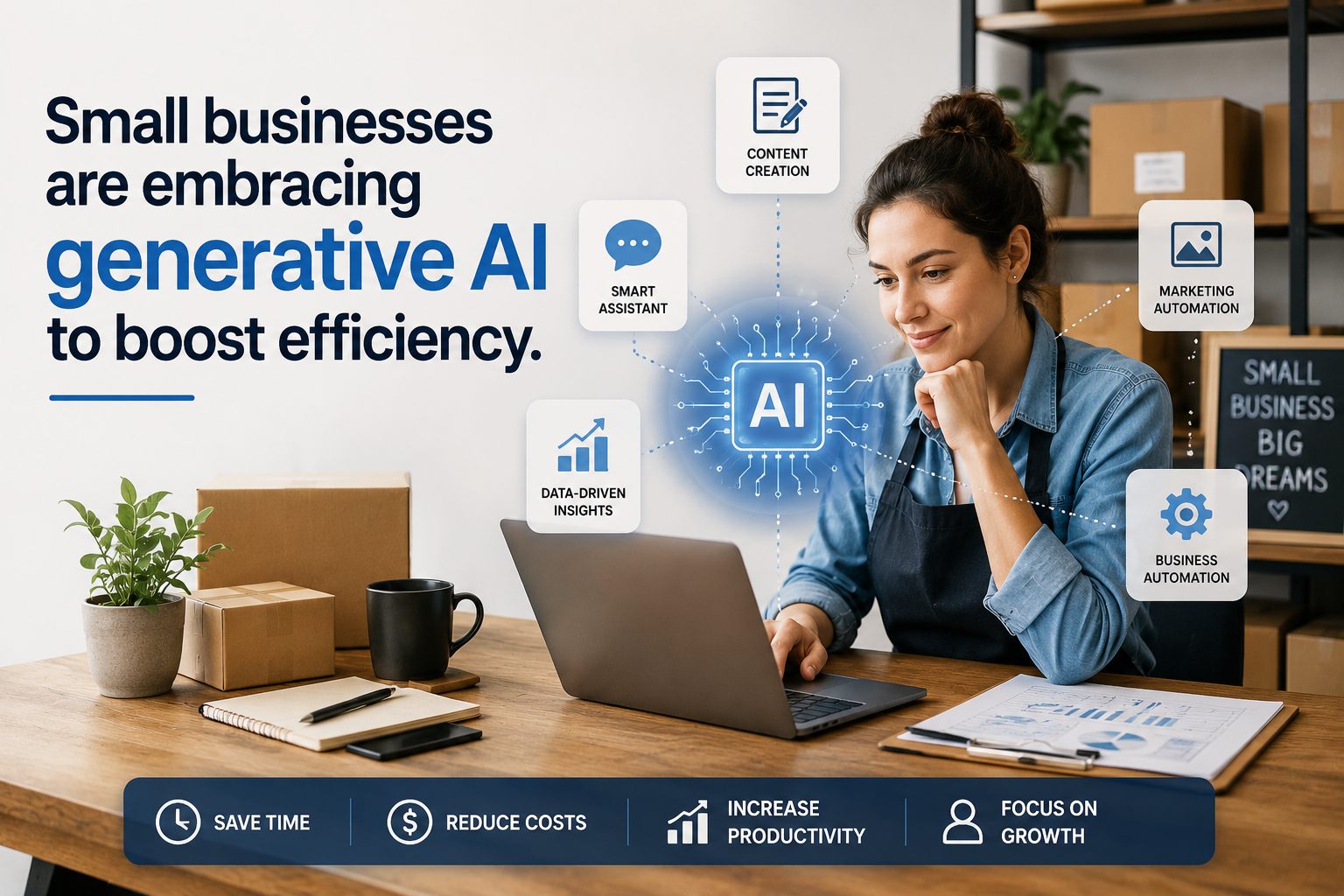
Small businesses are embracing generative AI to boost efficiency
Why generative AI is no longer just a headline for big tech
Once framed as the exclusive domain of giant tech firms, generative AI is now a practical toolkit for small and medium sized businesses. From marketing copy to customer support, from inventory management to product prototyping, entrepreneurs are finding that AI models can shave hours off routine tasks and unlock new revenue opportunities. The shift is both technological and cultural as owners look for ways to remain competitive without expanding payroll aggressively.
How small businesses are using generative AI today
The real world use cases are diverse and often surprisingly simple. Small teams are prioritizing areas that deliver quick returns and measurable impact.
Marketing and content creation
Small marketing teams use AI to draft email campaigns, social posts, product descriptions, and ad copy. Generative models accelerate ideation and allow testing of multiple variants in less time. For lean teams, that means maintaining a consistent content cadence without hiring additional writers.
Customer service and engagement
AI driven chatbots and automated response systems handle common inquiries, freeing staff to focus on complex or high value conversations. The result is faster response times, higher customer satisfaction, and lower support costs.
Product design and prototyping
Designers and makers use generative AI for rapid prototyping. From mockups to 3D model suggestions, these tools accelerate experimentation and reduce time to market for new product ideas.
Operational efficiency
Tasks such as invoice processing, scheduling, and inventory forecasting are increasingly automated. Small businesses can reduce human error and improve cash flow visibility by integrating AI with existing software.
Concrete examples from the front lines
A boutique marketing firm reported a 30 percent rise in billable output after adopting AI assisted copywriting. A regional retailer cut inventory holding costs by 18 percent using machine learning forecasts. A freelance design studio tripled its concept output while maintaining quality using image generation for mood boards. These are not theoretical gains. They are measurable improvements in revenue and margins.
Risks and trade offs small businesses must manage
Adoption is not without pitfalls. Business leaders must balance efficiency gains with reputational risk, data privacy, and potential bias in AI outputs.
- Data security and compliance remain top concerns when sharing customer information with third party AI services.
- Generated content can contain inaccuracies or hallucinations that harm credibility if not reviewed carefully.
- Over reliance on automation can erode customer relationships that benefit from genuine human interaction.
Best practices for responsible adoption
Successful small businesses follow pragmatic policies when deploying AI.
- Start with low risk pilots that have clear metrics and short feedback loops.
- Implement human in the loop review for customer facing outputs.
- Maintain data governance standards and limit the exposure of sensitive information.
- Train staff on how to use AI tools effectively and ethically.
Cost considerations and ROI
Subscription based AI tools lower the barrier to entry. Many platforms offer tiered pricing that scales with usage. For small businesses, the important calculation is not just tool cost but net value created. Faster content production, lower support overhead, and improved forecasting translate into measurable return on investment when tracked carefully.
The regulatory and ethical horizon
Policymakers are catching up. Upcoming regulations on AI transparency, data usage, and liability will affect tool selection and workflows. Small businesses should monitor developments and favor vendors that offer compliance features, audit trails, and clear data handling policies.
Looking ahead: where growth will come from
The next wave of value will come from vertical specific models and tighter integrations. Expect to see AI tools tailored to industries such as hospitality, legal services, healthcare administration, and retail merchandising. These specialized models will reduce the need for heavy customization and make AI adoption even more accessible to small operators.
FAQs
Is generative AI expensive for small businesses to adopt
Not necessarily. Many providers offer affordable subscriptions and pay as you go plans. Costs should be weighed against potential savings in labor and faster time to market.
How do small businesses protect customer data when using AI tools
Choose vendors with robust data policies, encrypt sensitive data, limit the data shared with third parties, and implement contract clauses that protect customer privacy.
Will AI replace employees in small companies
AI is more likely to augment roles than replace them entirely. Repetitive tasks are automated, allowing employees to focus on creative, strategic, and relationship oriented work.
What are the first steps for a business looking to adopt AI
Identify repetitive tasks that consume time, run a small pilot with defined success metrics, and involve staff in the selection and rollout of tools.
Conclusion
Generative AI is moving from concept to core business tool for small companies that are willing to experiment thoughtfully. When deployed with clear governance and human oversight, AI can boost productivity, improve customer experiences, and unlock new revenue streams. The keys to long term success are pragmatic pilots, vendor due diligence, and a culture that treats AI as a force multiplier rather than a shortcut.