The 5 Best OnePlus Phones Ever — A Retrospective
best OnePlus phones

As OnePlus pulls out of the US and Europe, it’s worth taking a moment to celebrate the best OnePlus phones the brand produced during its international run. Oppo has described the move as strategic, but whatever the reasons, OnePlus leaves behind a reputation for bold design choices, high performance and competitive pricing — the kind of legacy that earned it the “flagship killer” tag in its early years.
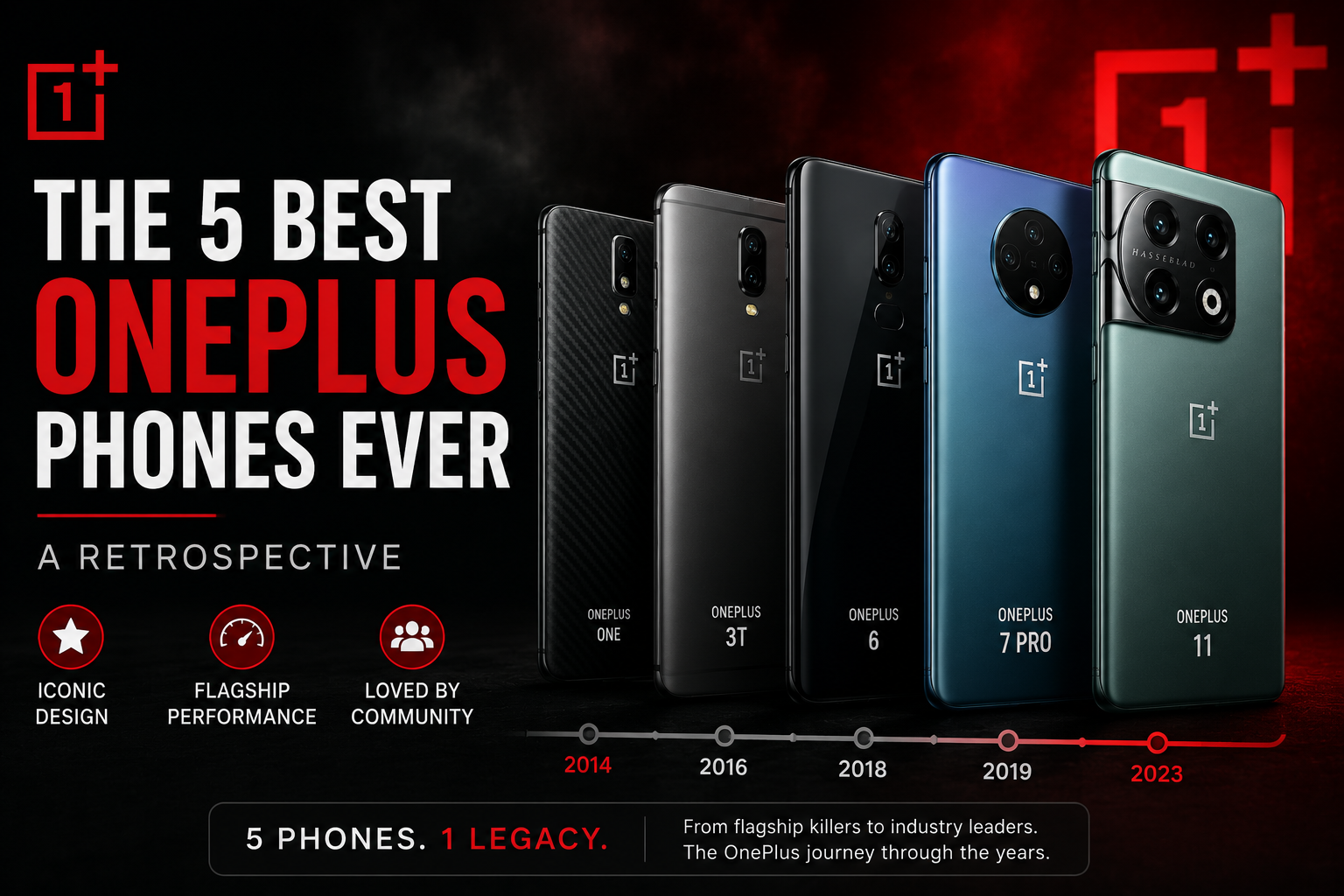
We won’t rehash the business decisions here; instead this piece revisits five models that defined the OnePlus phones list over the years. From the company’s disruptive debut to its later experiments with folding hardware and ultra‑capable flagships, these handsets show why OnePlus built such a loyal following. Below are three of the standout devices that helped shape the OnePlus legacy.
OnePlus One (2014) — the original ‘flagship killer’
The OnePlus One arrived in 2014 as a clear challenge to pricier flagships, and it practically rewrote expectations about what a budget should buy. Marketed as the “flagship killer” with the mantra “Never Settle,” it offered high-end internals — notably a Snapdragon 801 processor and 3GB of RAM — at a fraction of the cost of rivals at the time.
Part of the appeal was the software: shipping with CyanogenMod out of the box, the OnePlus One gave users more customization and a different Android experience than most OEM skins. Reviewers praised its build quality, performance and value, and many consumers were astonished that a device with those specs could be sold so cheaply. Even the 5.5‑inch display, which feels modest today, helped position the phone as a generous, serious contender back then.
Beyond specs, the OnePlus One signalled a new entrant willing to undercut incumbents while still delivering premium experiences — a strategy that set the tone for the brand’s early years.
OnePlus 7 Pro (2019) — the pop-up selfie and 90 Hz revolution
By 2019 OnePlus had matured beyond pure value plays and was experimenting with design and display technology. The OnePlus 7 Pro was the first to grab widespread attention since the original, thanks to its motorised pop‑up selfie camera and an immersive, notch‑free front. That clean look was backed up by a 6.67‑inch panel with a smooth 90 Hz refresh rate, which made animations and scrolling feel notably more fluid than most competitors.
Aside from the eye‑catching mechanics, the 7 Pro delivered flagship performance and very fast charging, and its glass and metal finish made it feel expensive in the hand. Pricing had crept closer to the mainstream flagships by this point, but the 7 Pro still offered a compelling mix of features and value compared with similarly priced rivals in 2019.
For many buyers the pop‑up camera was emblematic of OnePlus’s willingness to take design risks that paid off in everyday user experience — a thread that runs through much of the company’s best work.
OnePlus Open (2023) — a foldable done right
When foldables were still finding their footing, the OnePlus Open emerged as a standout effort that addressed many common compromises. TechRadar’s OnePlus review awarded it high marks for its displays, camera performance and a thin, light construction that made folding feel practical rather than gimmicky.
The Open’s internal display quality, hinge design and reduced crease all contributed to a more convincing package than many earlier folding attempts. OnePlus also tuned OxygenOS so the software adapted smoothly between folded and unfolded modes, delivering an experience that felt cohesive across use cases.
It was an expensive device — most book‑style foldables are — but the OnePlus Open justified its price by being one of the few foldables that didn’t feel like a compromise. For fans tracking the OnePlus legacy, the Open showed the brand could not only match incumbents in conventional phones but also compete meaningfully in the nascent foldable space.
OnePlus 13 (2024) — battery, performance and IP69 durability | best OnePlus phones
Among the best OnePlus phones, the OnePlus 13 marked a return to form for the brand, combining stamina, speed and an uncommon level of durability. It shipped with a huge 6,000mAh battery that redefined multi‑day endurance for a flagship‑class handset, meaning users could reliably get through heavy days of streaming, gaming and navigation without hunting for a charger.
Under the hood the 13 ran on Qualcomm’s Snapdragon 8 Elite, which delivered consistently smooth performance across demanding apps and multitasking—exactly the sort of responsiveness OnePlus has been known for in many of its flagship models. The phone’s 6.82‑inch display was large and vivid, making media and games feel immersive while still keeping frame rates and touch response snappy.
OnePlus also pushed the build quality forward by equipping the 13 with an IP69 ingress protection rating, its first device to hit that standard. Combined with a capable triple‑lens rear camera array and refined OxygenOS software, the 13 felt like a top‑tier package in almost every respect.
The main frustration was commercial rather than technical: like several recent OnePlus handsets, the 13 never gained meaningful carrier presence in the US, which hampered visibility and sales. For buyers who did find it, though, the OnePlus 13 stood out as a device that deserved wider recognition.
OnePlus 15 (2025) — the near-perfect finale
We’ll wrap up this list with the OnePlus 15, released last year and awarded a rare five-star rating in its TechRadar review. It impressed across nearly every category, delivering excellent battery life, top-tier performance, premium design, polished software, and solid durability. Simply put, it checked almost every box, leaving very little to criticize.
The OnePlus 15 also demonstrated that the company was still producing outstanding smartphones right up until its final releases in the US and European markets. Its biggest challenge wasn’t the hardware but its limited availability. Without a presence in major US carrier stores, the phone struggled to reach mainstream buyers, and purchasing it outright required a higher upfront cost.
Although it wasn’t the final OnePlus handset to launch internationally, the OnePlus 15 remains a fitting reminder of the company’s commitment to building high-quality smartphones. It stands comfortably alongside flagship devices from Apple, Google, and Samsung, making it disappointing that these phones will no longer be available to many consumers around the world.