
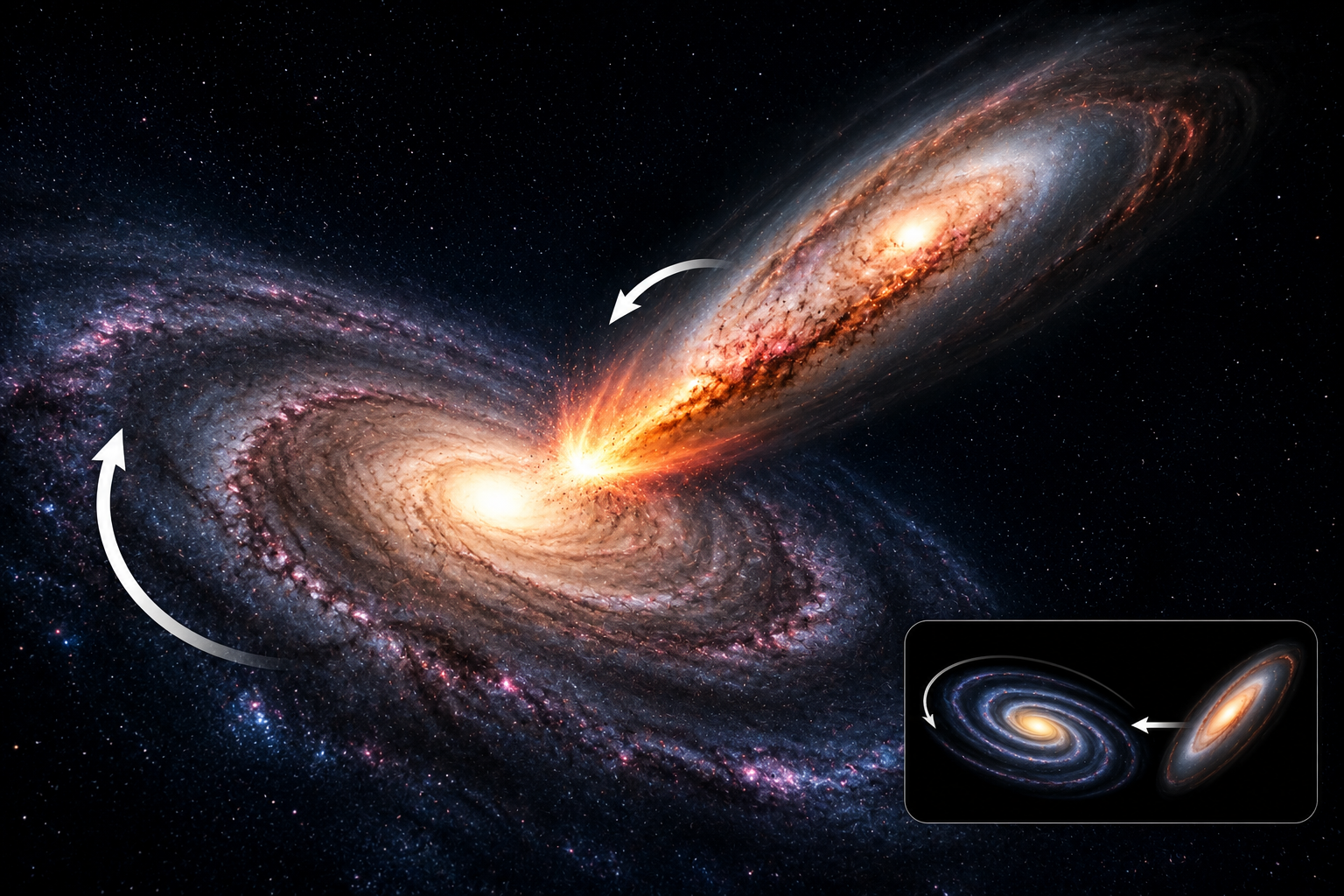
Milky Way flipped by Gaia Sausage collision 10 billion years
New research suggests the Milky Way flipped after a head-on impact with a dwarf galaxy about 10 billion years ago, long before our solar system formed. Astronomers say this cataclysmic encounter — known as the Gaia Sausage collision — likely reoriented our galaxy’s disc by more than 90 degrees.
Milky Way flipped
Durham University simulations show that a direct hit from a sizeable dwarf galaxy can produce a dramatic galaxy disc flip. The team found that galaxies similar to the Milky Way, when struck nearly head-on by an interloper the size of the Gaia Sausage, can be torqued into a new orientation over a few hundred million years.
How the discovery was made
Researchers investigating the surprisingly slow stellar halo rotation of the Milky Way used supercomputer models to reproduce the galaxy’s evolution. The halo is a roughly spherical, diffuse population of stars surrounding the disc, many of which originated in smaller galaxies that were later accreted.
Data from the European Space Agency’s Gaia mission had earlier revealed the mystery: while stars in the Milky Way’s disc orbit the centre at roughly 220 km/s, halo stars move far more slowly — around 25 km/s. The Durham team found a natural explanation in the aftermath of the Gaia Sausage collision and the subsequent disc flip.
What the Gaia Sausage tells us
The Gaia mission findings first identified the ancient impact in 2018, when astronomers traced a population of stars on extreme, sausage-shaped orbits back to a disrupted dwarf galaxy. Those peculiar orbits are a smoking gun: they point to a dwarf galaxy plunging straight through the Milky Way and breaking apart.
Although classed as a dwarf, the Gaia Sausage was substantial, with stars, gas and dark matter totaling more than 10 billion times the mass of the sun. That made it powerful enough to reshape the Milky Way, creating the central bulge and dominating much of the stellar halo.
Simulations and timescales
Durham University simulations indicate the flip is not instantaneous. The reorientation probably unfolds over at least a few hundred million years as gravitational interactions redistribute angular momentum across the disc and halo. Kirill Batrakov, lead author on the study, describes the process as gradual but decisive.
The models show that when a Gaia Sausage–sized object collides nearly head-on, the incoming body is torn apart and its stars are assimilated, while the torque exerted during the encounter can tilt the pre-existing disc into the position we see today.
- Cause: direct impact from the Gaia Sausage.
- Effect: galaxy disc flip of more than 90 degrees.
- Timescale: hundreds of millions of years to complete.
Legacy of an ancient galactic merger
Astronomers now regard the Gaia Sausage collision as the Milky Way’s last major merger and a defining episode in its history. The event qualifies as an ancient galactic merger that fundamentally altered the galaxy’s structure, sculpting the central bulge and contributing large numbers of halo stars.
The findings were presented at the Royal Astronomical Society’s National Astronomy Meeting in Birmingham, where the Durham team discussed how this scenario naturally explains the slow stellar halo rotation and the peculiar orbital signatures traced by Gaia.
What’s next for the Milky Way?
Major upheavals on the scale of the Gaia Sausage are rare. The next big encounter may be billions of years away, when the Large Magellanic Cloud is expected to merge with the Milky Way. A smaller merger with the Sagittarius dwarf galaxy is already underway, though its influence will be far less dramatic because Sagittarius is much less massive and the Milky Way itself is now much larger than it was 10 billion years ago.
These studies, combining Gaia mission findings with advanced computer modelling, are giving astronomers a clearer picture of how violent collisions shaped our galaxy and why features like stellar halo rotation appear as they do today.