Google Gemini 3.5 Pro Delay Signals Bigger AI Challenges
Gemini 3.5 Pro delay

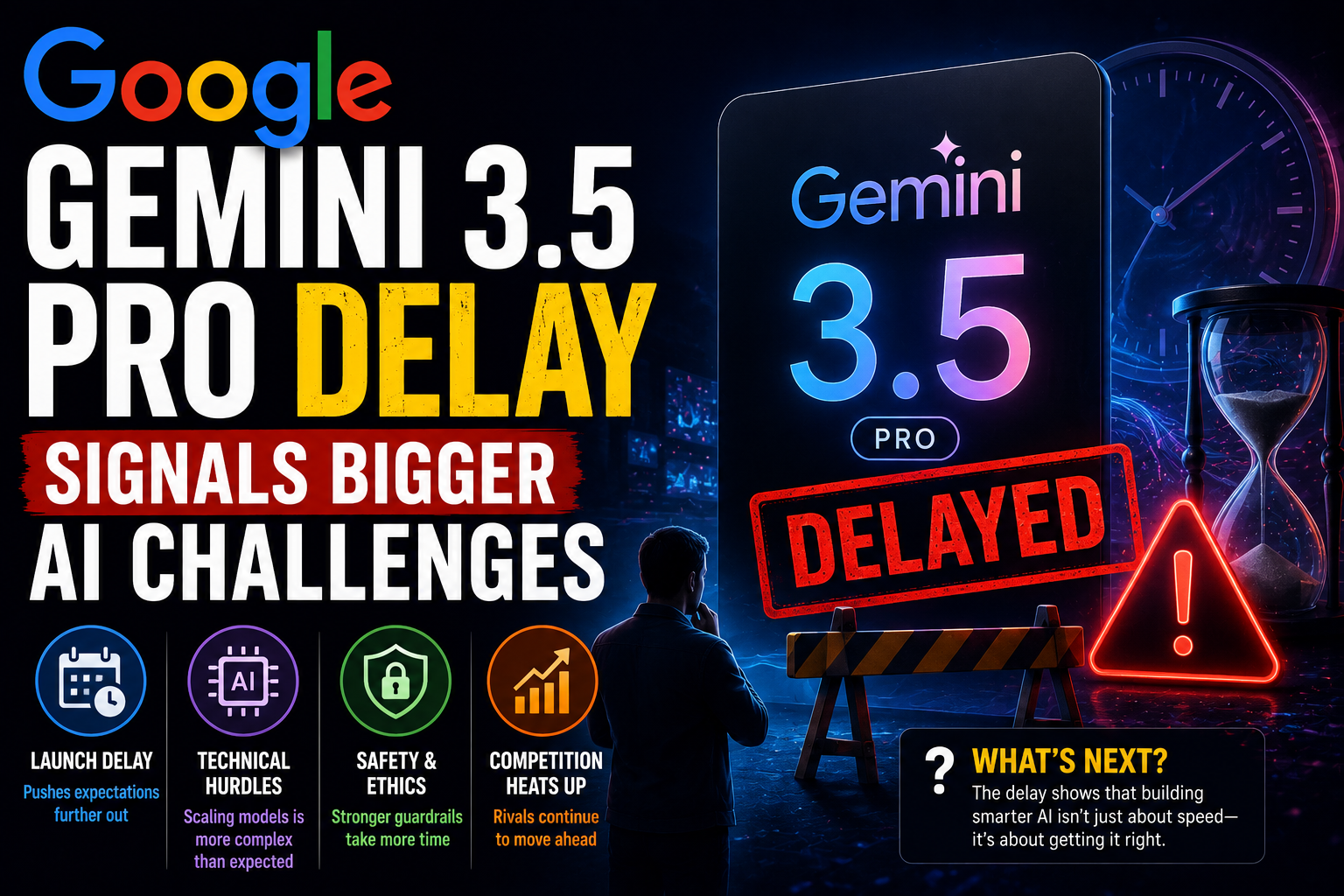
The Gemini 3.5 Pro delay underscores how difficult it has become for Google to move quickly in today’s fast-paced AI landscape. According to a Bloomberg report, the company is months behind its internal timetable for the next flagship model as engineers focus on improving one of Gemini’s most pressing weaknesses: coding performance.
This setback isn’t just about fine-tuning another conversational agent. It exposes a larger challenge for Google: coordinating massive engineering efforts, aligning multiple product teams and meeting stricter AI safety requirements—all while competitors ship new models at a faster clip.
Coding remains Gemini’s biggest challenge
Bloomberg, citing current and former employees, reports that Google delayed Gemini 3.5 Pro because its coding improvements fell short of expectations. Engineers even refreshed the model’s training data late in the development cycle to boost programming capabilities, but the gains reportedly didn’t match internal targets.
Writing and reasoning about code has become a clear battleground between leading AI systems. OpenAI, Anthropic and Meta have all invested heavily in developer-focused tools that can write, debug and reason through complex software projects. The Bloomberg account says that, at least for now, both OpenAI and Meta outperform Google’s publicly available models on many developer tasks.
Google maintains that work on Gemini 3.5 Pro is ongoing. In a statement cited by Bloomberg, the company said it is testing the upgraded Flash model and other systems with partners, while continuing conversations with US regulators about testing standards and AI safety. But many observers had expected a Gemini 3.5 Pro reveal at Google I/O earlier this year; instead Google showcased incremental updates while rivals unveiled new frontier models.
Scale is a double-edged sword for Google
Unlike most AI startups, Google must ensure every major Gemini release integrates across Search, YouTube, Maps, Android, Workspace, Cloud and many other products. That breadth delivers huge advantages—especially access to vast real-world data—but it also creates coordination overhead that can slow decisions.
Bloomberg’s sources describe competing priorities across DeepMind, Google Cloud, Android and other teams, along with overlapping AI coding efforts that make it harder to maintain a single, unified strategy. Earlier restrictions on using Gemini for software development also limited experimentation during the model’s early rollout, according to former employees.
Google says those policies have changed. The company now claims roughly 75 percent of its production code is generated using AI, and it is consolidating internal coding tools under a common platform called Google Antigravity. Engineers are reportedly expected to use AI for coding, though some continue to face computing-capacity limits because of intense internal demand for GPUs.
Internal churn, partner reactions and market pressure
The Bloomberg report also notes growing frustration within some parts of Google’s AI organization, with a number of researchers leaving for competitors such as Anthropic. At the same time, customer reactions to the Gemini 3.5 Flash model are mixed: companies like Figma have praised its speed-quality balance, while others, including education platform Platzi, view it as a middling option—costlier than previous Flash releases but not matching the reasoning capabilities of higher-end rivals.
In short, Google’s struggle is less about the basic ability to build frontier models and more about whether a company of its size can ship them fast enough. The industry now measures progress in weeks rather than months, and that tempo favors organizations able to move quickly even if that means accepting higher short-term risk.
- Google’s many products and teams create coordination challenges that can delay model launches.
- Gemini’s coding performance is a critical gap compared with OpenAI and Meta.
- Internal policy shifts, the Google Antigravity platform and heavy GPU demand are reshaping how Google’s engineers work.
- Market reaction to Gemini Flash models is mixed, adding pressure to improve both speed and reasoning quality.
The broader takeaway: Google helped ignite the modern AI race, but maintaining leadership now requires balancing rapid iteration with safety, product integration and enterprise-scale demands—no small feat in a field where rivals are sprinting ahead.