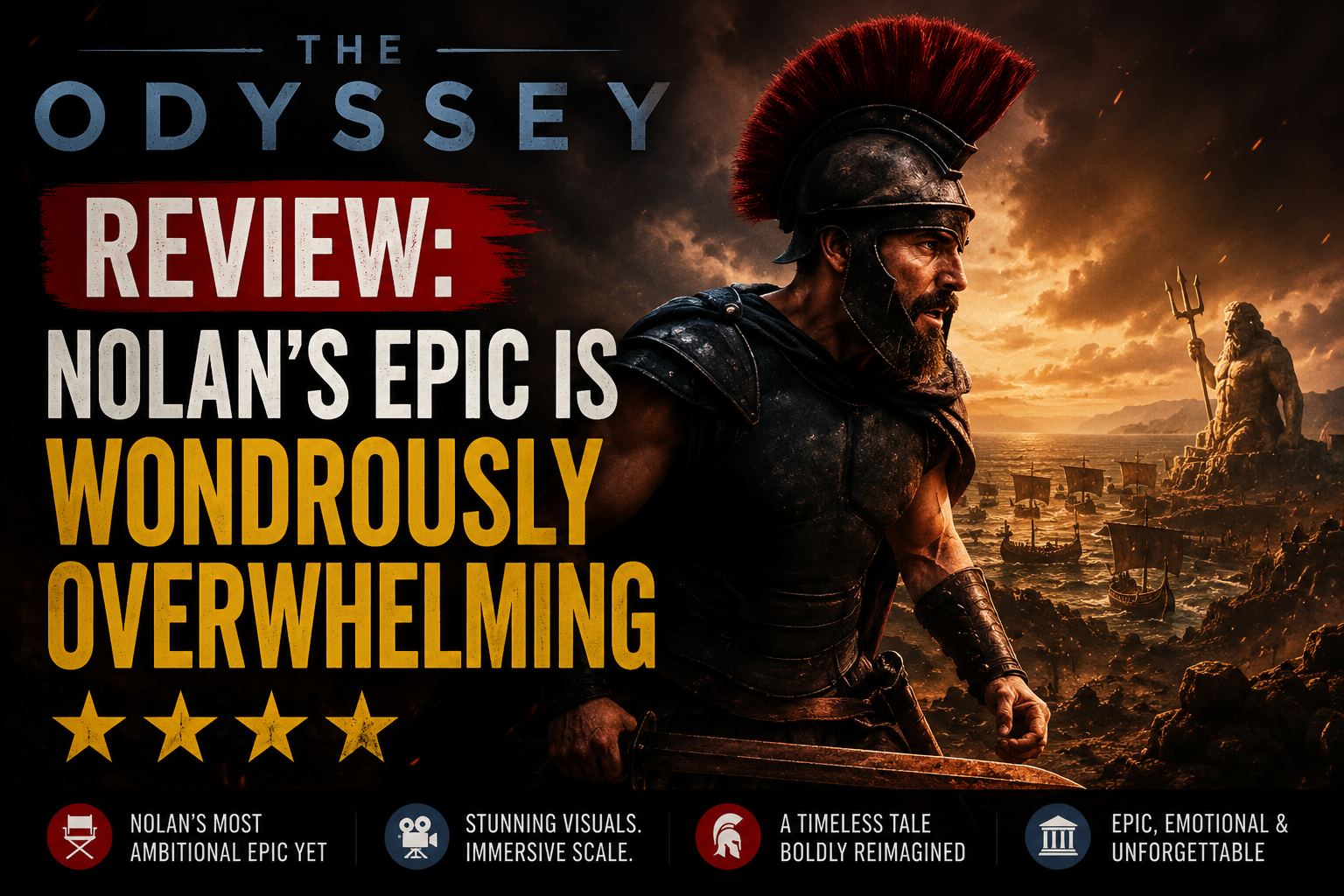
The Odyssey Review: Nolan’s Epic Is Wondrously Overwhelming
The Odyssey review — Hook and Overall Impression
The Odyssey review opens as an all-encompassing cinematic work that leaves you pleasantly and utterly spent, the kind of exhaustion that follows a brutal workout or a lavish feast. Christopher Nolan has built a film that feels less like a conventional movie and more like an expansive experience: massive, emotional, and overwhelmingly immersive.
It largely lives up to the sky-high expectations: a thrilling, often transcendent adaptation of Homer that occasionally falters only in comparison to its own peaks. Every scene packs energy and purpose, and the film’s scope—visually and emotionally—makes the few small stumbles feel minor. In short, it’s an awesome, deeply satisfying epic that comes very close to the perfection many hoped for.
Expectations and Context: Nolan Meets Homer
When Nolan announced he was tackling Homer’s saga, anticipation was instantaneous and intense. Bringing the director behind blockbuster, mind-bending films to a foundational piece of Western literature guaranteed scrutiny, and audiences expected both grandeur and fidelity.
Nolan’s version doesn’t try to be a textbook Homer adaptation movie; instead, he reinterprets the myth through his cinematic lens. He frames Odysseus’s journey in a way that respects the source material’s emotional core while injecting Nolan’s signature structural daring. The result is a film that feels both classic and distinctively Nolan: intimate in its relationships, monumental in its staging.
Complex Narrative and Multiple Timelines
At the film’s center is a dense narrative architecture. Nolan weaves decades of backstory, the Trojan War itself, and Odysseus’s postwar odyssey into a single, interlaced tapestry. That juggling act could have easily become confusing; instead, Nolan steadily reveals context so the emotional stakes remain clear.
The editing frequently jumps across time—childhood scenes, battlefield flashbacks, and long stretches at sea—yet transitions feel motivated rather than arbitrary. Names and moments trigger associative cuts, and the film trusts the audience to assemble the chronology as it goes. This approach deepens character motivations: we understand what Odysseus leaves behind, why his return matters, and how memory and consequence haunt every choice.
There are moments when the structure pauses for extended set pieces, which can narrow the narrative’s sweep. Still, the multiple timelines mostly enhance the mythic weight, giving Nolan room to explore regret, sacrifice, and the cost of heroism without flattening the story into a linear march home.
Rhythmic Editing and Pacing: From Jazz to Set Pieces
Early sections of the film have an improvisatory rhythm—almost jazz-like. One image or name will pivot the scene, sending the film into a different time or place with breathy, lyrical cuts. That elasticity creates momentum: the story feels alive, associative, and alive with possibility.
Ludwig Göransson’s varied, ethereal The Odyssey soundtrack underpins this flow, slipping between intimate motifs and sweeping orchestral washes that keep the film buoyant. The score often acts as a connective tissue, smoothing jumps and intensifying emotion.
But as the narrative shifts to battles and creature encounters, Nolan tightens his focus. Action sequences are concentrated and visceral, presenting a distinct cinematic flavor—more contained, more muscular. The contrast between the freewheeling early rhythm and the disciplined set pieces is sometimes jarring, making the film feel uneven in places. Yet that same contrast also highlights the film’s craftsmanship: when the movie moves from poetic interludes to brutal confrontations, both modes shine on their own terms.
Principal Characters and Key Performances
At the center is Matt Damon’s Odysseus, a commanding presence whose weary charisma anchors the film. Damon conveys a leader burdened by memory and consequence, a man driven homeward by love and stubborn pride. His performance gives the epic a human heart.
Anne Hathaway’s Penelope and Tom Holland’s Telemachus form the emotional counterpoint
Supporting Cast and Memorable Cameos
In this The Odyssey review, the supporting players lift the film from grand spectacle to lived world. Nolan populates Ithaca and the battlefield with a parade of familiar faces who turn brief moments into indelible impressions.
John Leguizamo’s Eumaeus provides quiet loyalty and warmth, while Jon Bernthal’s Menelaus gives Telemachus a gruff, urgent mirror to Odysseus’ past. Robert Pattinson’s Antinous is slimy and scheming without overstating the menace. Charlize Theron and Zendaya—Theron as the beguiling Calypso and Zendaya as Athena—bring celestial weight to their moments. Elliot Page and Himesh Patel add texture to Odysseus’ crew, and Samantha Morton’s Circe and Bill Irwin’s Polyphemus are small but show-stealing turns that let Nolan flirt with pure genre play.
- Standout cameos: Samantha Morton (Circe), Bill Irwin (Polyphemus), Lupita Nyong’o (Helen) — each transforms brief screen time into lingering impact.
- Ensemble strength: nearly every supporting actor elevates Damon, Hathaway, and Holland by grounding myth in human detail.
Set Pieces, Genre Shifts, and Standout Scenes
Nolan stages a surprising variety of set pieces, and the film’s genre shifts are one of its greatest thrills. Early sections feel lyrical and roaming; when the movie pivots to combat or supernatural encounters, the tone tightens into focused, brutal cinema. Those juxtapositions keep you off-balance in the best way.
Memorable sequences include the Homeric fury of the Trojan engagements, intimate and harrowing shipboard fights, and Circe’s sequence, which leans into horror with eerie, hallucinatory beats. The cyclops encounter is raw and tactile, a monster movie shot through with human peril. Back at home, the slow-building siege by the suitors delivers domestic drama that is as suspenseful as any monster scene. Each standout scene showcases a different facet of Nolan’s imagination—epic, intimate, eerie, and, ultimately, cathartic.
The Odyssey review
Christopher Nolan’s technical ambitions are on full display: the film was designed for 70mm IMAX and the results are immersive in a way few contemporary epics attempt. Shooting for a full-IMAX presentation means frame and scale are consistently monumental, a choice that trades occasional visual novelty for unrelenting presence.
Hoyte van Hoytema’s cinematography uses vast compositions to make landscapes feel elemental—mountains, seas, and battlefields occupy the screen with almost tactile clarity. Close-ups remain intimate, preserving the emotional core even amid spectacle. Ludwig Göransson’s score is versatile: ethereal motifs thread the film’s quieter, memory-rich passages, while percussion and horns drive the action with muscular force. For those able, a 70mm IMAX film viewing makes the sound design and dynamics of The Odyssey soundtrack reverberate in a way smaller formats can’t replicate.
Final Act, Themes, and Recommendation
The film’s final act rewards the investment: Odysseus’ return is less about surprise than payoff, and Nolan orchestrates emotions so that long-brewing heartbreak and hope collide. The homecoming scenes strip away spectacle when necessary and let character and consequence command the stage.
Themes of home, loss, memory, and the cost of leadership come into sharp focus. Matt Damon’s Odysseus is weathered but complex; Anne Hathaway and Tom Holland turn Penelope and Telemachus into more than symbols—their arc is the emotional ledger against which Odysseus’ sins and virtues are weighed. If you’ve wondered how a major Homer adaptation movie might balance mythic scope with human sorrow, Nolan’s answer is clear: sweepingly, and with tenderness.
Recommendation: see it on the biggest screen available. The 70mm IMAX presentation amplifies Christopher Nolan The Odyssey’s ambition and makes The Odyssey IMAX review conversations obvious—this is a film that benefits from scale. It won’t be flawless for every viewer, but it’s a richly rewarding, often breathtaking epic well worth your time.