Upcoming Technology Trends in 2026: What to Expect
Technology never stands still. Every year introduces new ideas that change how we communicate, work, learn, shop, and solve everyday problems. While some innovations take years to become mainstream, others quickly become part of daily life. As we move through 2026, businesses and consumers alike are paying close attention to the technologies that will shape the future.
The upcoming technology trends 2026 are expected to influence almost every industry, from healthcare and education to transportation and finance. Artificial intelligence is becoming more capable, connected devices are becoming smarter, and faster networks are opening the door to entirely new experiences. At the same time, organizations must balance innovation with privacy, cybersecurity, and responsible use of technology.
In this guide, we’ll look at the most important technology trends expected to make an impact in 2026 and explore how they could affect businesses, professionals, and everyday users.
Why Technology Trends Matter
Keeping up with technology isn’t only important for IT professionals. New technologies influence how companies operate, how customers interact with businesses, and how people complete everyday tasks.
Understanding emerging trends can help you:
-
Prepare for future career opportunities.
-
Improve business efficiency.
-
Make smarter technology investments.
-
Stay competitive in your industry.
-
Adapt to changing customer expectations.
Businesses that embrace useful innovations early often gain an advantage over competitors who are slower to adapt.
Overview of the Top Technology Trends in 2026
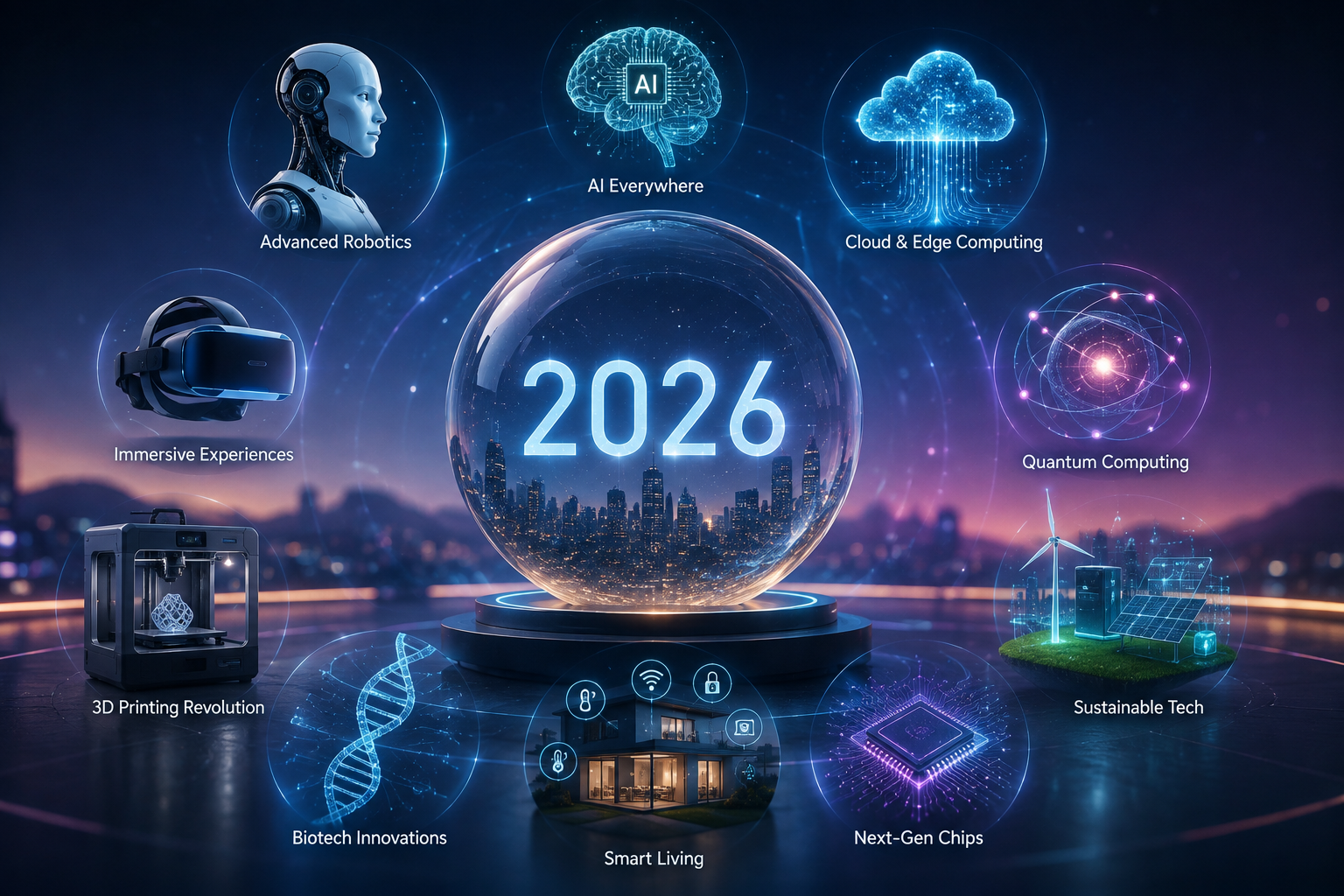
Several technologies are expected to receive greater attention during 2026.
| Technology | Expected Impact |
|---|---|
| Artificial Intelligence | Smarter automation and decision-making |
| Machine Learning | Improved predictions and data analysis |
| Internet of Things (IoT) | More connected homes and workplaces |
| Extended Reality (XR) | Better training, education, and entertainment |
| Quantum Computing | Faster solutions for complex problems |
| 5G and Advanced Connectivity | Faster communication and lower latency |
| Autonomous Vehicles | Continued development of self-driving technology |
| Cybersecurity | Greater focus on protecting digital assets |
Artificial Intelligence Continues to Evolve
Artificial intelligence remains one of the biggest driving forces behind technological innovation.
In 2026, AI is expected to become even more integrated into everyday life through smarter software, virtual assistants, automation tools, and business applications.
Businesses are already using AI to:
-
Analyze customer behavior.
-
Automate repetitive tasks.
-
Improve customer support.
-
Generate reports.
-
Enhance productivity.
Consumers are also benefiting from AI through personalized recommendations, smarter mobile devices, and improved voice assistants.
Rather than replacing people, AI is increasingly being used to help employees work more efficiently and make better decisions.
Machine Learning Becomes More Practical
Machine learning continues to improve how systems learn from data.
Instead of relying solely on programmed rules, machine learning models identify patterns and make predictions based on information they process over time.
This technology is being used in areas such as:
-
Healthcare
-
Banking
-
Retail
-
Manufacturing
-
Cybersecurity
As machine learning becomes more accessible, businesses of all sizes are expected to adopt these tools to improve operations and customer experiences.
Smarter Homes Through the Internet of Things
The Internet of Things (IoT) connects everyday devices to the internet, allowing them to communicate and automate routine tasks.
Smart homes continue to grow in popularity thanks to devices such as:
-
Smart thermostats
-
Smart lighting
-
Security cameras
-
Video doorbells
-
Smart appliances
-
Voice assistants
If you’re planning to build a connected home, check out our guide to the Best Smart Home Devices for 2026 to explore the latest smart home technologies.
Instead of controlling each device separately, homeowners can manage multiple systems from a single mobile app or voice command.
This trend is expected to expand further as more connected devices become compatible with one another.
Extended Reality Is Expanding Beyond Gaming
Extended Reality (XR), which includes virtual reality (VR), augmented reality (AR), and mixed reality (MR), is moving beyond entertainment.
Businesses are beginning to use XR for:
-
Employee training
-
Remote collaboration
-
Product demonstrations
-
Education
-
Healthcare simulations
Retail companies are also exploring augmented reality experiences that allow customers to preview products before making a purchase.
As hardware becomes more affordable, XR is expected to become increasingly common across multiple industries.
Quantum Computing Moves Closer to Real-World Applications
Quantum computing remains one of the most exciting areas of technology.
Although still in development, it has the potential to solve extremely complex problems much faster than traditional computers.
Possible future applications include:
-
Medical research
-
Financial modeling
-
Climate forecasting
-
Scientific simulations
-
Logistics optimization
While widespread commercial adoption may still take time, continued progress is expected throughout the coming years.
Faster Connectivity With 5G Networks
The rollout of 5G networks continues to improve internet connectivity worldwide.
Compared with previous generations, 5G offers:
-
Faster download speeds
-
Lower latency
-
Better support for connected devices
-
More reliable mobile connections
These improvements benefit industries such as remote healthcare, online gaming, smart cities, and autonomous transportation.
As network coverage expands, more applications will take advantage of these higher speeds.
Autonomous Vehicles Continue to Advance
Self-driving technology continues to evolve, although fully autonomous transportation is still being developed.
Manufacturers are investing heavily in:
-
Advanced sensors
-
Artificial intelligence
-
Navigation systems
-
Driver assistance features
While fully autonomous vehicles are not yet common on public roads, significant improvements are expected in safety, navigation, and assisted driving technologies.
Cybersecurity Remains a Top Priority
As technology becomes more connected, protecting digital information becomes increasingly important.
Businesses and individuals face growing cybersecurity challenges, including:
-
Data breaches
-
Ransomware attacks
-
Identity theft
-
Phishing scams
Organizations are investing in stronger security systems, employee awareness training, and AI-powered threat detection to reduce cyber risks.
Many organizations also rely on secure cloud platforms to store and share business data. Learn more in our comparison of the Best Cloud Storage Services in 2026.
Cybersecurity is likely to remain one of the most important technology priorities throughout 2026.
How These Trends Will Impact Businesses
The upcoming technology trends 2026 are expected to influence businesses of every size.
Some of the biggest changes include:
-
Increased workplace automation
-
Better customer experiences
-
Improved business intelligence
-
Faster communication
-
More flexible remote work
-
Smarter supply chain management
Companies that embrace new technologies thoughtfully will be better positioned to compete in rapidly changing markets.
The Impact on Everyday Life
Technology doesn’t only affect businesses—it also changes how people live.
Consumers can expect improvements in areas such as:
-
Home automation
-
Healthcare services
-
Online education
-
Digital banking
-
Transportation
-
Entertainment
Many routine activities are becoming faster, more personalized, and more convenient through connected technologies.
Challenges That Come With Emerging Technologies
While innovation creates exciting opportunities, it also introduces new challenges.
Some concerns include:
-
Privacy protection
-
Data security
-
Ethical use of artificial intelligence
-
Digital inequality
-
Job displacement through automation
Governments, technology companies, and businesses will need to work together to ensure these technologies are developed responsibly.
What Industry Experts Are Saying
Several respected organizations continue to monitor global technology developments.
According to Gartner, organizations should continue investing in cloud computing, cybersecurity, artificial intelligence, and digital transformation to remain competitive.
McKinsey also emphasizes that businesses embracing digital innovation are better positioned to improve efficiency, increase productivity, and respond to changing customer expectations.
Meanwhile, research from the Pew Research Center shows that while many people are optimistic about the future of technology, they also expect companies to address concerns related to privacy, security, and responsible innovation.
These insights highlight the importance of balancing technological progress with public trust.
How Individuals Can Prepare
You don’t need to become a technology expert to benefit from these developments.
Simple ways to prepare include:
-
Learning new digital skills.
-
Following industry news.
-
Exploring AI productivity tools.
-
Improving cybersecurity awareness.
-
Staying open to new technologies.
Continuous learning will remain one of the most valuable skills in an increasingly digital world.
Frequently Asked Questions
What are the biggest upcoming technology trends 2026?
Some of the most significant trends include artificial intelligence, machine learning, the Internet of Things, extended reality, quantum computing, advanced 5G networks, autonomous vehicles, and cybersecurity innovations.
Why is artificial intelligence important in 2026?
Artificial intelligence helps automate tasks, improve decision-making, enhance customer experiences, and increase productivity across many industries, making it one of the most influential technologies of the year.
How will technology affect businesses?
Businesses are expected to benefit from smarter automation, better data analysis, improved customer service, enhanced security, and more efficient operations through the adoption of emerging technologies.
Is quantum computing ready for everyday use?
Quantum computing is still developing, but researchers and technology companies continue making progress. While widespread consumer use may take time, its future applications could transform scientific research, healthcare, and finance.
How can people prepare for future technology trends?
Staying informed, learning new digital skills, understanding cybersecurity best practices, and remaining adaptable to technological change are some of the best ways to prepare for the future.
Final Thoughts
The upcoming technology trends 2026 demonstrate that innovation continues to reshape the way we live and work. Artificial intelligence, connected devices, advanced networks, and emerging technologies are creating new opportunities across nearly every industry while also introducing important discussions about privacy, security, and responsible development.
Rather than trying to predict every technological breakthrough, individuals and businesses should focus on understanding the trends most relevant to their goals. By staying informed, embracing continuous learning, and adapting to change, you’ll be better prepared to take advantage of the opportunities that technology will bring in 2026 and beyond.