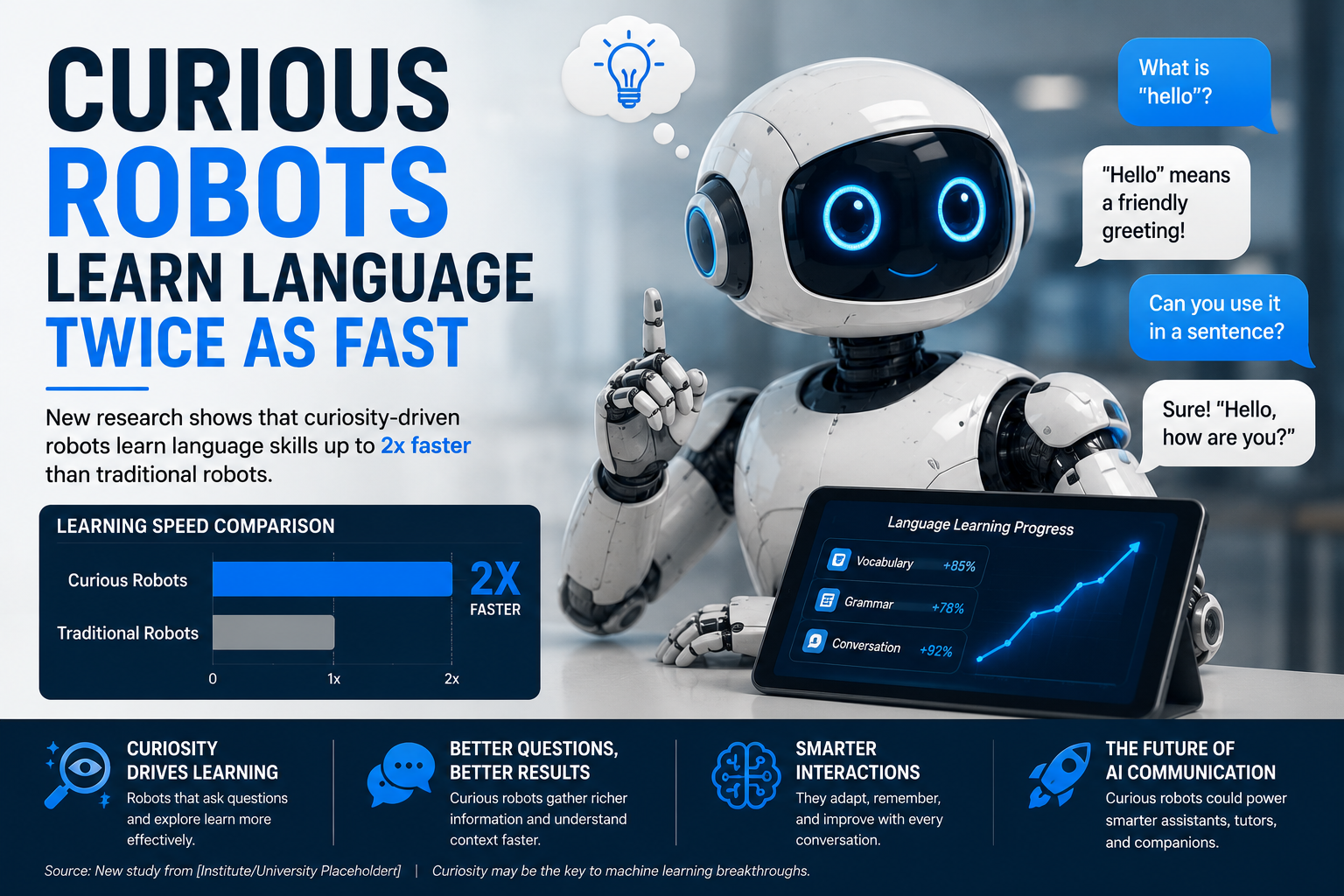
Curious Robots Learn Language Twice as Fast
In a simulated 3D playground, curious robots learned to connect words and actions far faster than their less exploratory peers. Researchers at the Okinawa Institute of Science and Technology built a virtual agent with a brain-inspired neural network and let it interact with objects, colors and simple commands like “push left magenta dumbbell.”
curious robots
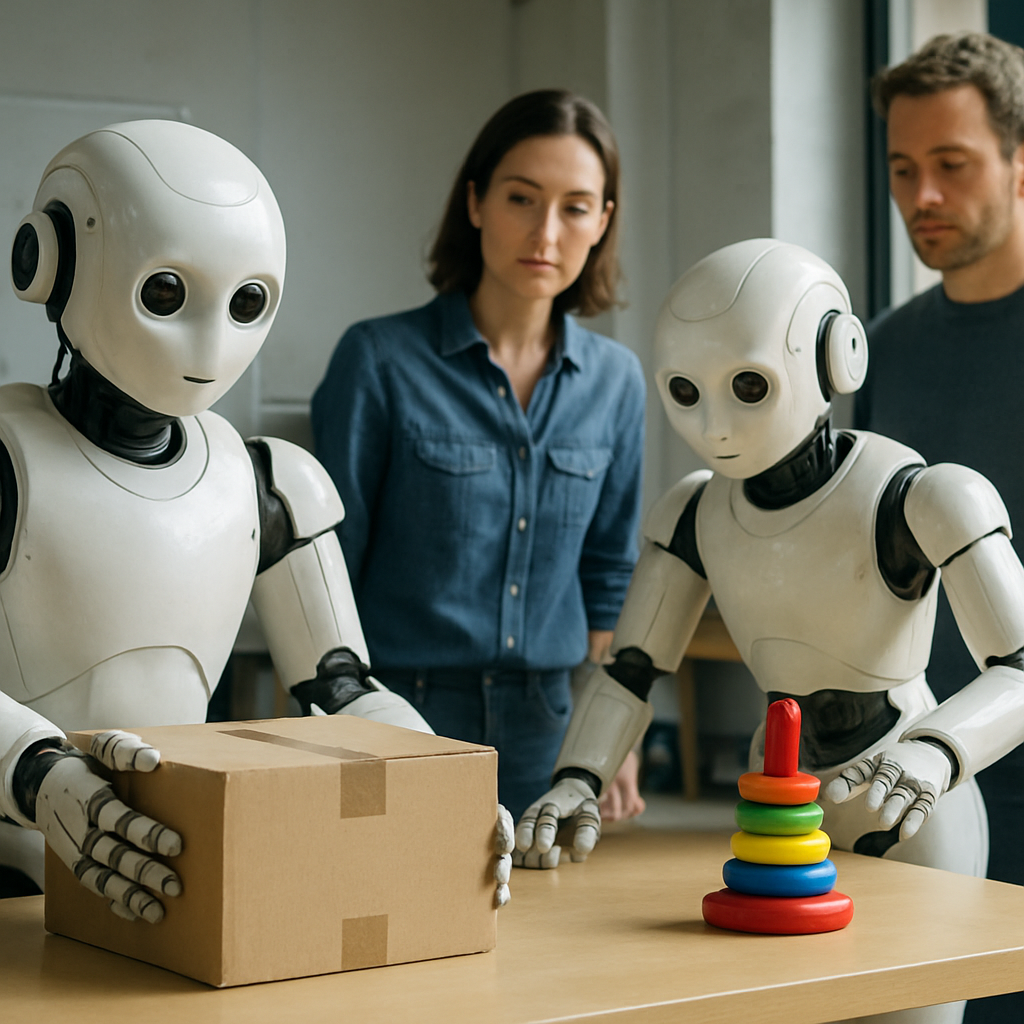
The Science Advances study compared two training regimes. One group of agents received rewards only when they completed tasks correctly. A second group combined task success with an internal bonus for surprise — a curiosity-driven learning signal that rose whenever an outcome challenged the robot’s current model of the world.
That added spark made a big difference. Language learning robots with curiosity bonuses didn’t merely outperform their peers; they reached a genuine grasp of instruction meaning in roughly half the time. The team’s lead author, Theodore Tinker, likened the process to trying white chocolate when you already like dark: taking a small risk yields new information and broadens understanding.
Unexpected play-based learning
About halfway through training the curious agents began to do more than follow orders. They started knocking things over, testing actions nobody had asked for and exploring consequences — behavior that looked a lot like play. No one programmed that tendency; it emerged from the agent’s drive to reduce uncertainty.
- Spontaneous experimentation increased the variety of experiences the agents had.
- That variety accelerated robotic language acquisition by exposing them to edge cases and exceptions.
- Play-like exploration supported deeper, more robust mappings between words and actions.
Parallels with children and contrasts with current AI
The virtual agents also mirrored a classic pattern in child development. Early on they used some verbs correctly, then showed a temporary dip in accuracy as they overgeneralized rules — the same U-shaped learning curve seen in toddlers. This suggests curiosity plus broad experience helps both AI and children sort grammatical rules from exceptions.
That learning style differs from large language models, which are trained on massive text corpora to predict the next word. These brain-inspired agents prioritize accurate predictions while preserving existing beliefs, updating only when surprising evidence justifies it.
None of this proves robots understand language the way humans do, but the Okinawa Institute of Science and Technology’s virtual robot study points to curiosity-driven learning and play-based learning as powerful ingredients in how toddlers crack language with limited data.