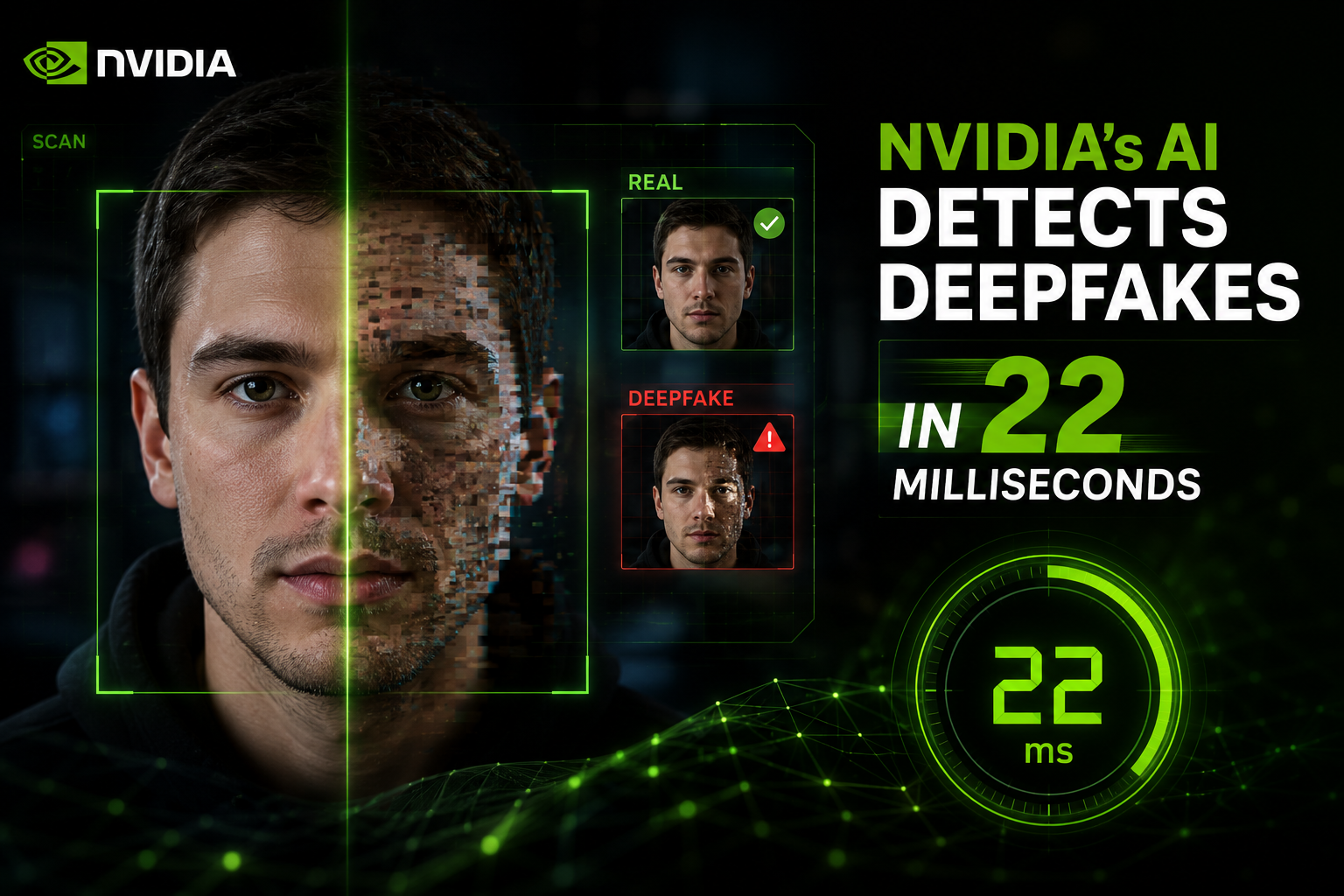
NVIDIA’s AI Detects Deepfakes in 22 Milliseconds
As generative AI produces videos that can be nearly indistinguishable from real footage, deepfake detection has become critical to stopping misinformation before it spreads. At SIGGRAPH 2026, NVIDIA introduced the NVIDIA Synthetic Video Detector, an AI-driven verification tool designed to flag AI-generated video quickly and reliably for newsrooms, broadcasters and enterprises.
deepfake detection
NVIDIA positions the detector not as a replacement for traditional fact-checking or forensic review, but as an additional, automated layer of verification. Built into NVIDIA’s NIM microservices, the system can be dropped into existing workflows so organizations don’t need to build new moderation stacks from scratch. That integration is intended to make real-time deepfake detection practical in production environments.
How the detector works
The model examines video frame by frame and produces a probability score that indicates whether footage is likely generated or manipulated with AI. NVIDIA highlights speed as a major advantage: on RTX systems the tool can evaluate a 1080p frame in as little as 22 milliseconds, enabling near-live review of incoming streams and recorded clips.
Performance and limitations
NVIDIA reports strong accuracy on high-quality sources, claiming up to 92% accuracy on uncompressed video. But the company is transparent about the limits: compression can erode detectable artifacts, and accuracy drops to about 87% when videos are compressed by 15% and to roughly 82% at 50% compression. This compression impact on detection is a persistent challenge because platforms such as YouTube, TikTok and Instagram routinely recompress uploads.
- Speed: 22 milliseconds per 1080p frame on RTX hardware enables real-time or near-real-time analysis.
- Accuracy: up to 92% on uncompressed video; lower on compressed files.
- Integration: available via NIM microservices for pipeline deployment.
- Benchmarking: ranked highly on the AI GVD Bench, an industry measure of synthetic media detectors.
The company’s internal charts show the detector outperforming many established models across a range of AI video generators, and NVIDIA says it sits near the top of the AI GVD Bench. Still, the firm acknowledges the tool isn’t a silver bullet: human verification, source-checking and editorial context remain essential parts of any responsible workflow.
Where it fits in verification workflows
NVIDIA is targeting newsrooms and enterprises that need AI-generated video verification without rebuilding tooling from the ground up. By offering video forensics tools as modular microservices, organizations can add automated screening to existing editorial and moderation pipelines. The detector’s speed and scoring output are meant to prioritize content for human review rather than to make final authenticity judgments independently.
To broaden availability, NVIDIA plans to integrate the Synthetic Video Detector into Wowza Intelligence Video Framework, which the company says reaches more than 35,000 deployments in 170 countries. That rollout aims to put fast, automated scrutiny into the hands of more broadcasters and publishers worldwide.
As generative systems continue to improve, the dynamic is shifting: building convincing synthetic media is now matched by efforts to detect it. Tools like NVIDIA’s Synthetic Video Detector reflect the idea that the other half of advancing AI is creating systems that can help people know when not to trust what they see.