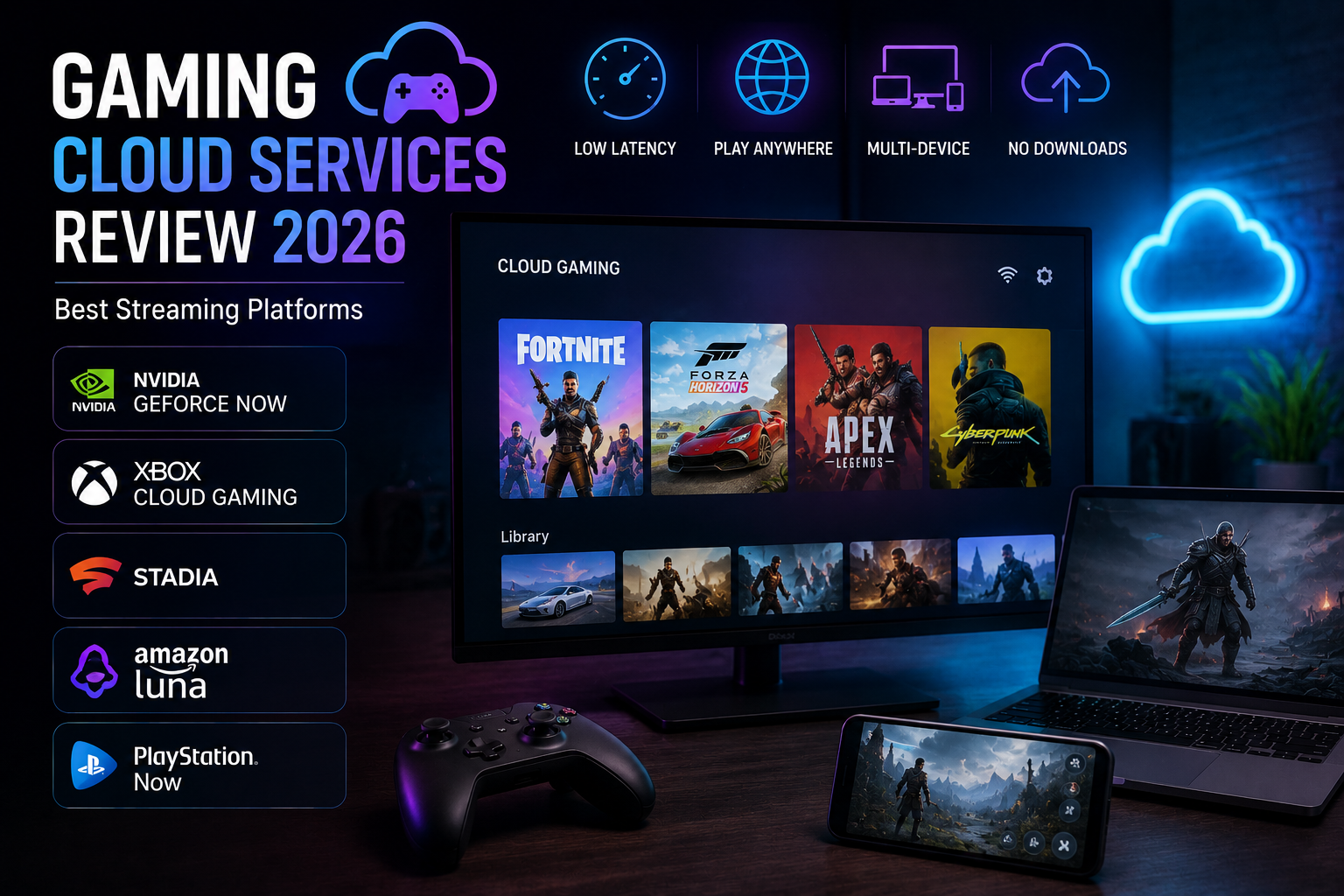
Gaming Cloud Services Review 2026: Best Streaming Platforms
Why Gaming Cloud Services Matter in 2026
Cloud gaming in 2026 has matured from an experimental convenience to a mainstream purchase consideration for gamers of all kinds. With faster networks, broader hardware compatibility, and more competitive pricing, the idea of playing high-end titles without a local flagship GPU is now practical for many. This review examines the leading Gaming cloud services—NVIDIA GeForce Now, Xbox Cloud Gaming, and PlayStation Plus Premium—to help you choose the best streaming platform for your needs.
What I Tested and Why it Matters
Across services I tested load times, average latency, image quality, library access, device support, and subscription value. Real-world testing used a mix of 5GHz Wi-Fi (Wi-Fi 6E) and a 200 Mbps wired connection to reflect common 2026 home setups. Results were weighted by the features that matter most to modern players: responsiveness for competitive titles, image fidelity for AAA games, and platform compatibility for multi-device households.
How Gaming Cloud Services Compare in 2026
Below is a concise comparison of the three services covered in this review. For full specs and current plans visit each provider’s site: NVIDIA GeForce Now (https://www.nvidia.com/en-us/geforce-now/), Xbox Cloud Gaming (https://www.xbox.com/en-US/play), PlayStation Plus (https://www.playstation.com/en-us/ps-plus/).
- GeForce Now — Best for PC gamers who own a library of purchased titles and want high-frame-rate streaming with RTX effects.
- Xbox Cloud Gaming — Best value for Xbox Game Pass Ultimate subscribers and cross-save support across console and PC ecosystems.
- PlayStation Plus Premium — Best for PlayStation loyalists wanting native catalog access and some exclusive streaming titles.
NVIDIA GeForce Now — The Performance-Focused Option
GeForce Now remains the top choice for gamers prioritizing raw streaming quality and hardware-accelerated features like ray tracing. In my tests it produced the sharpest visuals at high bitrates and handled fast-paced games with minimal artifacting. Session lengths and priority access tiers deliver predictable performance during peak hours.
Pros:
- Excellent image quality and RTX support
- Works with existing game libraries on storefronts like Steam and Epic
- Wide device support including PC, Mac, Android, and select smart TVs
Cons:
- Requires you to own or buy games separately in many cases
- Subscription tiers can be confusing for new users
Xbox Cloud Gaming — The Best Value for Subscription Players
Xbox Cloud Gaming is compelling for anyone already on Xbox Game Pass Ultimate. The strength here is the integrated library—hundreds of titles ready to stream—plus tight cross-play and save-state continuity with consoles. Performance is excellent on wired and strong Wi-Fi connections, and latency is competitive for most genres.
Pros:
- Huge game catalog included with Game Pass Ultimate
- Seamless integration with Xbox ecosystems and Smart Delivery
- Broad device reach including mobile, PC, and select TVs
Cons:
- Not all titles support cloud saves identically across platforms
- Peak-hour performance can vary by region
PlayStation Plus Premium — Best for PlayStation Exclusives
PlayStation Plus Premium blends a streaming catalog with access to classic titles and timed demos. It is the go-to if PlayStation exclusives are your priority. Image quality and latency have improved significantly since 2024, but the service still lags slightly behind GeForce Now in pure graphical fidelity on identical connections.
Pros:
- Access to PlayStation exclusives and curated classics
- Good cross-platform support for modern devices
Cons:
- Smaller cloud-native library compared to Xbox Game Pass
- Premium tier pricing model may not be cost-effective for casual players
Who Should Choose Each Service?
- Choose GeForce Now if you value image fidelity, RTX features, and want to stream purchased PC libraries.
- Choose Xbox Cloud Gaming if you want the best subscription value and a vast, rotating catalog via Game Pass.
- Choose PlayStation Plus Premium if PlayStation exclusives and legacy titles are central to your gaming identity.
Pricing and Value (2026 Snapshot)
Subscription pricing has settled in 2026 with competitive monthly and annual tiers. Xbox Game Pass still offers arguably the best price-per-game for regular players, while GeForce Now’s paid tiers target users seeking short-term high performance rather than a vast included library. PlayStation Plus Premium positions itself as a niche service for brand-loyal players. For up-to-date pricing check the providers’ pages linked above.
FAQs
Q: Can cloud gaming replace a PC or console?
A: For many casual and mid-core gamers, yes—especially if they prioritize convenience over owning hardware. Competitive players and creators who require guaranteed frame rates may still prefer local hardware.
Q: Do I need a fast internet connection for cloud gaming?
A: A stable wired connection or a strong Wi-Fi 6/6E connection helps. For 1080p60 expect at least 15–25 Mbps; for higher fidelity and HDR, 50–100 Mbps is recommended. Real-world performance also depends on local latency and server proximity.
Q: Are my saved games synced across devices?
A: Most platforms support cloud saves, but behavior varies. Xbox Cloud Gaming integrates closely with Xbox/PC saves. Check individual game and platform compatibility before assuming full cross-device continuity.
Authoritative Context
Market trends and adoption rates for cloud gaming are tracked by industry analysts like Newzoo (https://newzoo.com/) and provider specifications are available on official sites such as NVIDIA (https://www.nvidia.com/en-us/geforce-now/) and Xbox (https://www.xbox.com/en-US/play).
Conclusion
Gaming cloud services in 2026 offer real, practical alternatives to local hardware for many players. GeForce Now excels for image quality and RTX features; Xbox Cloud Gaming delivers the best subscription value through Game Pass; PlayStation Plus Premium serves PlayStation loyalists with exclusive content. Your choice should depend on whether you prioritize image fidelity, catalog breadth, or platform exclusives. Test trials remain the best low-risk way to confirm which service matches your home network and gaming habits.