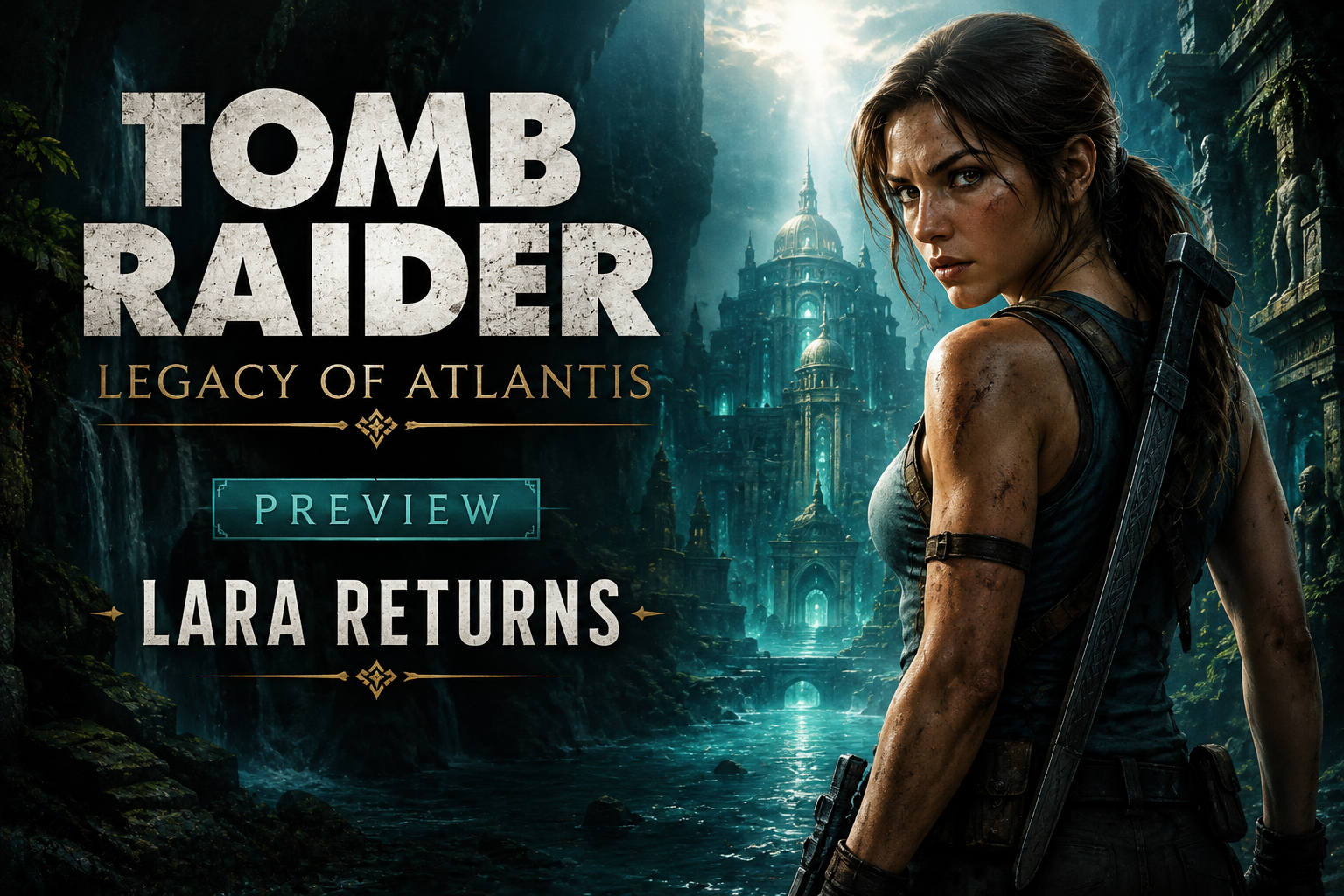
Tomb Raider: Legacy of Atlantis Preview: Lara Returns
Tomb Raider: Legacy of Atlantis may be the modern Lara Croft revival many fans have been waiting for. A hands-on preview shown at Summer Game Fest 2026 highlighted a vivid jungle setting, tactile traversal, demanding puzzles and a dramatic return for dinosaurs. Yet the demo also raised a major question: how far does this reimagining really go?
The preview focused on one compact slice of Lara’s Peruvian adventure. It was polished, attractive and immediately familiar, but it was also carefully contained. That makes it difficult to judge the full scope of the project, especially when the game is being positioned as a reimagining rather than a straightforward remake.
What was shown, however, suggests that Lara Croft’s next adventure is leaning into both nostalgia and modern action-adventure design. The result could be a strong blend of classic tomb raiding and contemporary spectacle.
Tomb Raider: Legacy of Atlantis brings Lara back to the jungle
The demo area placed Lara in a dense rainforest filled with ruined stonework, waterfalls, hidden passages and ancient mechanisms. It was a fitting showcase for the series’ strongest visual identity: nature reclaiming forgotten places.
Crystal Dynamics appears to be pushing the environment as more than scenery. The jungle was built as a navigable space, with secret routes, overgrown paths and vertical traversal opportunities. Lara could cut through blocked passages, leap across broken ruins and search side areas for collectibles.
The setting also looked striking. Thick vegetation, detailed ruins and elaborate water effects helped sell the idea of a lost location with history beneath every surface. Based on this slice, the game could become one of the most visually impressive entries in the series.
That is notable because Lara’s recent history already includes the visually ambitious Survivor trilogy. If this new project can maintain the same environmental quality across larger areas, it may give the series a fresh technical identity for current hardware.
Tomb Raider: Legacy of Atlantis and the question of scale
The biggest unknown is scale. The preview offered a focused, curated section rather than a broader look at the campaign structure. It showed how one area works, but not how exploration, progression or optional content will connect over time.
That matters because the difference between a remake and a reimagining is substantial. A remake often rebuilds a known game with updated technology. A reimagining can alter pacing, mechanics, story emphasis and level structure while preserving core ideas.
For now, the demo confirms the tone more than the full design philosophy. The game respects classic Tomb Raider ingredients, but it is not yet clear how boldly it will reinterpret them.
Puzzles mix old-school challenge with modern guidance
The central objective in the preview involved an ancient water-and-gear puzzle guarding a massive gate. It felt designed to echo the more demanding puzzle logic of older Tomb Raider games while still using modern readability.
The challenge did not appear to hand every solution to the player. At the same time, it was not completely opaque. That balance is important for a series built on observation, spatial reasoning and experimentation.
Strong Tomb Raider puzzles often succeed because they make players study the room. A good solution feels earned, not delivered. The previewed puzzle seemed to understand that rhythm, combining visible mechanisms with enough mystery to keep the player engaged.
It also helped that the area encouraged exploration. Searching side corners for ornaments, trinkets and hidden details gave the location a stronger sense of purpose. Still, the long-term value of these discoveries remains unclear.
Collectibles need meaning beyond menus
The demo included objects to find, but it did not fully explain whether they will matter beyond collection tracking. That is a key point for modern adventure games.
Collectibles can be rewarding when they support world-building, unlock side objectives or lead to more substantial secrets. They are less satisfying when they simply fill a menu. Fans will likely want to know whether Tomb Raider: Legacy of Atlantis treats hidden items as meaningful discoveries or simple completion counters.
For more on how the wider genre has evolved, see our guide to modern action-adventure game design.
Lara Croft feels more grounded and vulnerable
Lara herself appears to be one of the strongest parts of the preview. Alix Wilton Regan’s performance gives this version of the character a human quality, with acting that supports a less invincible interpretation of the icon.
Movement also seems more grounded. Lara can still perform dramatic leaps and agile maneuvers, but the animation and input feel weightier than the most exaggerated versions of the character. Acrobatics remain stylish, yet they appear physically believable through the controller.
This more vulnerable approach changes the mood of combat and traversal. Lara does not come across as an unstoppable action figure. Instead, she feels capable but breakable, which adds tension when enemies close in or a jump demands precision.
That balance could be crucial. The best versions of Lara Croft are both extraordinary and exposed. She should feel skilled enough to survive impossible places, but not so powerful that danger disappears.
Modern tools without excessive hand-holding
The preview also showed updated tools and gadgets. These appeared designed to help players read the environment without turning exploration into a guided tour.
One scanning effect visually wrapped across ruins, making the tool clear on screen without overwhelming the scene. This kind of presentation can be useful if it remains optional or restrained.
The game also introduces a focus ability. It works similarly to a bullet-time system, slowing the action and giving Lara a tactical advantage. The ability is built through well-timed dodges and acrobatic moves, encouraging active play rather than passive waiting.
This addition could make combat more expressive. It rewards timing, movement and composure, which fits a version of Lara who survives through agility as much as firepower.
Dinosaur combat gives the preview its biggest thrill
For longtime fans, the return of dinosaurs is one of the clearest nostalgic hooks. The preview included a fight against three velociraptors, with Lara relying on her familiar handguns and evasive movement.
The encounter highlighted the importance of dodging, positioning and using focus at the right moment. The enemies were not just targets. They forced movement and created pressure, making Lara’s vulnerability more noticeable.
The demo then ended with a Tyrannosaurus Rex chase. That sequence leaned into spectacle and panic, using the game’s upgraded presentation to turn a famous Tomb Raider idea into a modern action set piece.
If that moment reflects the rest of the game, Tomb Raider: Legacy of Atlantis may be able to deliver large-scale adventure without losing the danger and discovery that define the franchise.
What the preview showed — and what remains unknown
The demo made a strong first impression, but it did not answer every important question. A compact preview can prove that a game feels good in motion. It cannot confirm campaign pacing, level variety or the depth of optional content.
| Shown in the preview | Still unclear |
|---|---|
| Lush rainforest environments with ruins and waterfalls | How large and open the full areas will be |
| Water-and-gear puzzle design | How complex later puzzles become |
| Grounded Lara movement and acrobatics | How progression develops across the campaign |
| Focus ability and dodge-based combat flow | How varied enemy encounters will be |
| Velociraptor fight and T. Rex chase | How often the game uses major set pieces |
| Collectibles and hidden routes | Whether secrets connect to deeper rewards |
These unanswered points are not necessarily concerns. They are simply the limits of a short demo. Still, they will shape how players understand the project before launch.
Release platforms and official sources
Tomb Raider: Legacy of Atlantis is scheduled to launch on February 12, 2026, for PlayStation 5, Xbox Series X and Series S, and PC. Players can follow updates through the official Tomb Raider website and the Crystal Dynamics website.
The game was shown in connection with Summer Game Fest, one of the industry’s major showcase events. Platform details can also be tracked through official PlayStation and Xbox channels.
For related coverage, read our breakdown of upcoming PS5 and Xbox adventure games and our overview of the evolution of Tomb Raider.
Conclusion: a promising reimagining that needs a bigger reveal
Tomb Raider: Legacy of Atlantis already looks like a confident return for Lara Croft. The jungle setting is beautiful, the puzzles appear thoughtfully balanced, and the dinosaur encounters bring back a sense of pulpy danger that fits the series well.
Most importantly, Lara seems enjoyable to control again. Her movement has weight, her tools feel modern, and her vulnerability gives combat a sharper edge.
Even so, the preview leaves plenty to prove. The game must still show how its reimagining works across a full adventure, not just one impressive section. If Crystal Dynamics can expand on this foundation, Tomb Raider: Legacy of Atlantis could become the glow-up Lara Croft needed.